How to Get a Google Phone Number for Free and When You Should Use It
Google Voice is the legitimate way to get a Google phone number for free, and for the right use cases, it's genuinely solid. But there's a layer underneath that most walkthroughs skip entirely: the number you get is typically classified as VoIP in carrier lookups, and that classification follows it into nearly every platform that checks. The setup is easy. The surprises come later.
- • How to Get a Google Phone Number for Free and When You Should Use It
- • What the free Google Voice number actually includes
- ◦ Who can sign up and who gets left out
- ◦ What you actually get at no cost
- ◦ Where the free label quietly ends
- • How to get a Google phone number for free (step-by-step)
- ◦ What you need before you start
- ◦ The desktop setup walkthrough
- ◦ The verification step that trips most people up
- • Where a free Google phone number genuinely works well
- ◦ Keeping your personal number off public listings
- ◦ Separating a side hustle from your personal life
- ◦ Low-stakes communication that doesn't depend on carrier verification
- • The verification trap: why Google Voice numbers often get rejected
- ◦ How platforms detect that your number is VoIP
- ◦ Real situations where a free Google number lets you down
- • When a dedicated verification service is the smarter call
- ◦ What the problem actually is and why Google Voice can't fix it
- ◦ How Text-Verification.net approaches this differently
- • When a Google phone number for free is enough, and when it isn't
- • The honest takeaway
By the end of this, you'll know exactly who qualifies for Google Voice, how to set it up, where it works well, where it quietly fails, and what to reach for when it's the wrong tool for the job.
What the free Google Voice number actually includes
Who can sign up and who gets left out
The free personal tier is available to US residents using a personal Google account. You need to be physically located in one of the 48 contiguous states at the time you sign up. US territories including Puerto Rico, Guam, American Samoa, the Northern Mariana Islands, and the US Virgin Islands are explicitly excluded.
If you're using a Google Workspace account, Google Voice for Workspace is tied to paid plans and has its own country list across Belgium, Canada, France, Germany, the UK, and others. That's a separate product with different rules.
What you actually get at no cost
The free tier is more generous than people assume. You get a real US phone number, unlimited calls and texts within the US and Canada, voicemail with transcription, call forwarding to linked devices, and mobile apps for both Android and iOS.
Where the free label quietly ends
International calls require separate credits. Emergency 911 calling is not supported on the free tier at all. Call recording and 3-way calling require paid plans. Voice Starter runs $10 per month; Voice Standard runs $20 per month. Porting an existing number into Google Voice costs a flat $20 fee.
How to get a Google phone number for free (step-by-step)
What you need before you start
You need three things: a personal Google account, a US location, and an existing US phone number that can receive a text message or a voice call. That third requirement surprises a lot of people. You need a working phone to get your Google number. If you're trying to use Google Voice specifically because you don't have a phone number yet, this is exactly where the process stalls.
The desktop setup walkthrough
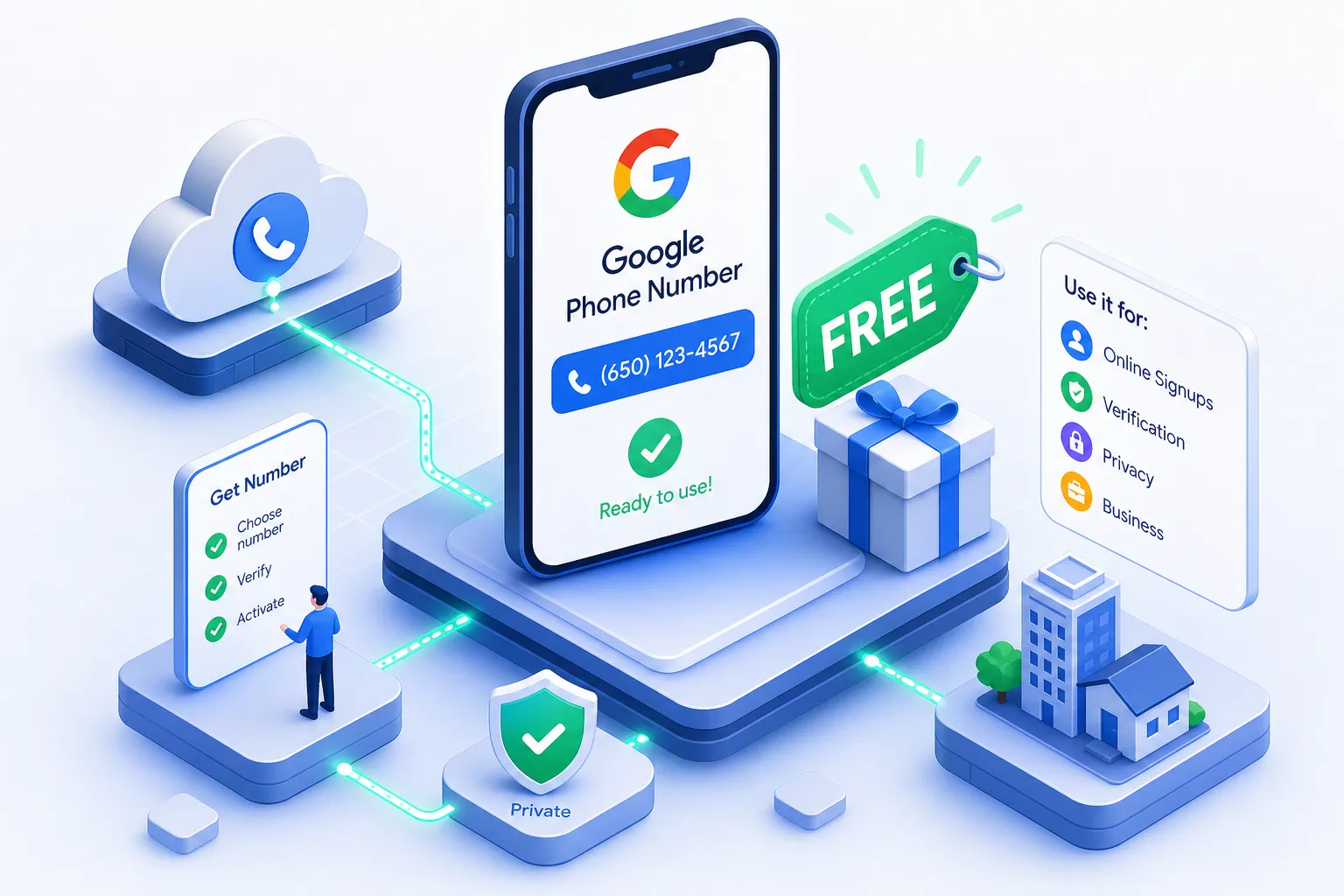
Go to voice.google.com and sign in to your Google account. Accept the Terms of Service and Privacy Policy, then search for available numbers using a city name or area code. When you find a number you want, click Select and follow the on-screen prompts. Most people finish in under five minutes.
The verification step that trips most people up
After you choose your number, Google sends a 6-digit code to your existing phone via text or voice call. Where it breaks down: if the number you're using to verify is a VoIP line or another internet-based number, the verification code may not arrive. This is the first place where the VoIP classification issue shows up, and it's not the last.
Where a free Google phone number genuinely works well
Keeping your personal number off public listings
If you sell on Facebook Marketplace, post on Craigslist, list a rental property, or use dating apps, handing out your real cell number is an unnecessary risk. A Google Voice number gives you a clean buffer. Calls and texts still reach you through the app, but you can mute, block, or delete the number entirely if you need to.
Separating a side hustle from your personal life
Freelancers, consultants, and small business owners regularly use Google Voice as a lightweight business line. You get a number that sounds professional without buying a second SIM or committing to a phone plan.
Low-stakes communication that doesn't depend on carrier verification
For giving clients a callback number, receiving non-critical texts, or forwarding calls to your main device, Google Voice works reliably. The scenario where it breaks down is specific: when a third-party platform runs a check on your number type before sending a verification code, a VoIP number will often fail that check before the code even sends.
The verification trap: why Google Voice numbers often get rejected
How platforms detect that your number is VoIP
Most platforms that send SMS verification codes run a carrier lookup before delivery. These lookups use number intelligence APIs from providers like Twilio, Sinch, and Telnyx that return a line-type classification: mobile, landline, VoIP, or prepaid. Google Voice numbers are typically classified as VoIP in these lookups. When a platform's rules say to block VoIP numbers, your verification code never sends. The lookup happens before delivery, so the rejection is structural, not situational.
Industry estimates suggest that somewhere in the range of 70 to 80 percent of major platforms now enforce some form of VoIP filtering on SMS verification flows. Banks, payment processors, crypto exchanges, and SaaS tools handling user data are consistently among those that reject VoIP numbers outright.
Real situations where a free Google number lets you down
Trying to verify a Stripe account, set up a new Amazon seller profile, or sign up for a financial app with a Google Voice number will likely result in rejection. The same is commonly true for WhatsApp, Instagram, most crypto platforms, and dating apps including Tinder, Bumble, and Hinge, which frequently reject VoIP numbers during sign-up. These aren't edge cases — they're common, everyday workflows.
When a dedicated verification service is the smarter call
What the problem actually is and why Google Voice can't fix it
Google Voice was built for communication: calls, texts, voicemail, forwarding. It was not built to pass carrier verification checks as a trusted mobile number. A free VoIP number will always carry the same classification fingerprint. Workarounds like call forwarding or routing tricks generally don't change the line-type result that a carrier lookup returns.
How Text-Verification.net approaches this differently
Text-Verification.net is built specifically for the verification use case. For developers and businesses who need numbers that reliably receive SMS codes and pass carrier checks, a purpose-built service handles the deliverability and compliance layer that a free virtual number simply can't provide. If you're integrating verification into an application, onboarding users at scale, or running workflows that depend on SMS delivery guarantees, our temporary numbers are architected for exactly that.
When a Google phone number for free is enough, and when it isn't
The decision comes down to stakes and context. If you need privacy for a side project, a buffer number for personal listings, or a lightweight second line for a small freelance operation, getting a Google phone number for free is a genuinely solid choice. If you need reliable SMS delivery, the ability to pass carrier checks on financial or identity-sensitive platforms, or a number that won't be flagged as virtual by lookup APIs, a purpose-built service is the right investment.
These aren't really competing options. They're tools designed for different jobs, and most people who understand the distinction end up using both, each in its correct context.
The honest takeaway
Getting a Google phone number for free is real, and the process is simpler than most guides make it sound. The features on the free tier are legitimate, the privacy use cases are solid, and for personal communication, Google Voice holds up well.
But the classification issue that most walkthroughs never address is this: VoIP numbers carry a line-type label that follows them into every carrier lookup, every verification check, every platform that cares about number type. Match the tool to the job. Use Google Voice for what it's genuinely great at. Recognize early when a use case needs SMS delivery guarantees or a number that passes carrier verification — and choose accordingly.